Showing posts with label parasurama. Show all posts

Thursday, June 4, 2020

Temple for Vaidyanathan who Cures Epilepsy and Many Other Chronic Diseases


Lord Shiva has been worshiped in many forms and one among them is Vaidyanathan. The concept of Vaidyanathan is related to the curing of chronic diseases. It can be equated with the Dhanvandari concept of Lord Maha Vishnu. There is a temple dedicated to this Bhava of Lord Shiva in Kerala and that is Puramundekkad Shiva Temple. It is also known as Porandekkad Shiva Temple.
If you go to previous pages of this blog, you will come across the legend related to the formation of Kerala. It is believed that Parasurama, the sixth incarnation of Lord Vishnu created this land. After creating the land, he had constructed 108 Shivalayas (Temples of Lord Shiva) to protect the land from evil spirits. Puramundekkaad or Prandekkad Shiva Temple is one of them. 

There is one another legend saying the installation of the idol has been done by Hara Maharshi.
Years have passed since then and the temple constructed by Parasurama got abandoned. People who used to reside in this locality have migrated to different other places and the area has become a thick forest. People from the villages used to go inside the forest to collect wood logs for their cooking purpose. Once, such a group of villagers who went inside the forest witnessed a flame of fire in the atmosphere. It was moving slowly and the villagers followed it to reach a place where a one-foot tall Shivalinga was found. Surprised with it the villagers collected flowers from the nearby plants and worshiped the god with devotion. They offered a few plantain fruits also.
puramundekkad shiva temple

Later the nearby villagers gathered there and constructed a temple for Lord Shiva. Here in this temple, Lord Shiva is in the Bhava of Vaidyanathan. As per the Hindu belief, epilepsy is caused by a Yaksha with the name Apasmaara. Here, the divine concept is that the Vaidyanathan is performing Thandava Dance upon this Yaksha. In other words, the Yaksha is in total control of Lord Shiva here. Hence, devotees believe that epilepsy and other chronic diseases can be cured by this power.

Another interesting fact is the offering of plantain fruit. It is a practice for the people residing in the nearby villages to offer the first product from their plantain cultivation to God. When you give it, the same will be taken inside the temple and will be offered to the Lord. After that, it will return to you but the sweetness will be lesser then. It is believed that Lord Shiva is accepting the sweet nectar inside the fruit.

This ancient temple is located in the Ponnani Taluk of Malappuram district. It is a swayambhoo linga and is facing towards the east. Unlike in other Shiva temples, there are two Nandi idols are being worshiped here. Apart from the main deity, Lord Vishnu, Ganapati, Dakshinaamoorthy, Ayyappan, Sri Krishna is also worshiped here. The temple is just 2 km away from Edappal Bus stand.

Sunday, May 31, 2020

Kottiyoor Temple; the Origin of Shakthi Peethas


Kottiyoor Shiva Temple is one of the most prominent Shiva Temples in Kerala. Although its original name is Vadakeswaram Temple, it is most popularly known as Kottiyoor Temple due to its proximity to the Kottiyoor Village. There are two temples located on either side of the River Bavali. The one on the Eastern bank is known as Ikkare kottiyoor (Kottiyoor on this bank) and the one on the western bank is known as Akkare Kottiyoor (Kottiyoor on that bank). Ikke Kottiyoor will be open all the year for worship when the Akkare Kottiyoor will be open only for 27 days every year during the festival season. The Kottiyoor Pilgrimage during these 27 days is an important thing for devotees. This place is known as the origin of Shakthi Peethas and also the one and the only place on the planet earth where you will get protected from the evil effects of Kaliyuga.
Kottiyur Temple


What is Shakthi Peethas

King Daksha was not in a mood to send his daughter Sati in marriage to Lord Shiva but that could not change the minds of Sati. Lord Shiva and Sati got married against the will of her father Daksha Prajapati and it left vengeance in the minds of Daksha. Hence, he did not invite Lord Shiva when he organized a Yagna where he invited all other gods and goddesses. He did it purposefully to insult Lord Shiva. Though he took it lightly, Sati Devi could not. She went directly to the Yagnashala and asked her father why he did not invite her husband. Furious Daksha started insulting Shiva describing him as a barbarian and naïve. She just could not digest those words and committed suicide there itself.
Hearing the news of his beloved wife’s suicide, Lord Shiva arrived at the venue and forced himself inside the yagna shala. Nobody and none in the universe could bar the furious lord. He killed Daksha. However, he could not contain his fury just by killing Daksha. He took out the body of his beloved on his shoulders and started Thandava Dance. Heatwaves have started emitting from the body of Shiva which became unbearable for the living things in the universe. Seeing the destruction of the universe, Lord Vishnu appeared there and cut the body of Sati Devi into fifty-one pieces with his Sudarshan Chakra. Each piece fell at different places and these places became serene places where a devotee can converse directly with the divine power of Ma Sati. These places are known as Shakthi Peethas.
Kottiyur Temple


Kottiyoor, the place where Daksha organized his Yagna


It is believed that Daksha organized his Yagna at Kottiyoor. He started his yagna on a Vishakham star day but could not complete it as he was killed by Lord Shiva. Later Lord gave life back to Daksha on the request of Lord Brahma and went back to the Himalayas to undergo penance. Years have passed and eras have passed. The place became a dense forest where the tribal known as Kurichyaas used to inhabit. One day a Kurichya youth rubbed his arrow over a piece of rock to sharpen it and suddenly blood started oozing out from the rock.
Hearing the news, the Kurichya community leaders gathered at the place, and upon the advice of an elder, they approached an old Brahmin staying in a nearby village. He came there and inspected the rock. Suddenly he felt the presence of divine power in it. He summoned the village astrologer. Astrologer came and examine various possibilities. Finally, he identified the power as of Lord Shiva and the old Brahmin performed some immediate rituals with Koovala (Crataeva Religiosa) leaves.
Later, it has been confirmed that there is the presence of Sati Devi also. It has been found at the present day “Ammarakalu Thara”, a lifted piece of rock near to the Swayambhoo Linga. It is believed that Sati Devi committed suicide at this place. As it is barred to construct a temple based on some religious principles, only makeshift temples will be constructed during the festival seasons here. Another interesting fact is that the devotees can visit this temple only during the 27-day festival season which starts on the Swathi star of Malayalam month Idava.
Kottiyur Temple festival

Kottiyoor Temples on Either Side of River Bavali

Whatever we mentioned earlier is about “Akkare Kottiyoor, or the Kottiyoor Temple on the eastern bank of the River Bavali. There is another temple on the western bank which is called Ikkare Kottiyoor or Thricherumana Temple. The idol in this temple has been consecrated by the great Sage Parasurama. The intention of this was to facilitate devotees to worship Lord Shiva the entire year whereas they can do the same on the other the temple during the festival seasons. Later Jagadguru Adi Shankaracharya fixed different types of rituals to be performed in both these temples. When Shankaracharya visited this place, it was not the festival season and hence he has not crossed the river to visit Akkare Kottiyoor. He designed the rituals for Akkare kottiyoor from the temple located on the other side of the river.
It is believed that Lord Brahma and Vishnu are also present here inside the shrine. Hence, the Kali, (The figure that represents Kaliyuga) promised Parasurama that he will never enter inside the temple. That is the importance of this temple. This is the only place on the earth where the devotees will get protection from the evil effects of Kaliyuga.

Kottiyur

Kottiyoor Pilgrimage

Pilgrimage to Akkare Kottiyoor will be during the 27 days of the festival and it starts with the Swathi star of Idavom (Malayalam month. Pilgrimage to Akkare Kottiyoor witnesses the participation from all classes of the Hindu community. In reality, each community has designated with bringing some specific materials which are used in different rituals being carried out in this temple. This duty has been allocated by the Royal Family of Pazhashi King.
As mentioned earlier, there is no permanent temple structure here and temporary structures will be constructed during the festival season. The right to mark different places for different deities lies in people from the Asari community whereas the right to perform the first Abhisheka is on the Kurichya community chief. Umbrellas made with palm leaves will be placed at different Devasthanas and the right to bring these umbrellas is of the people belong to the Kaniya community. The ghee for Abhishekam will be brought by the people belonging to the Nair community and the coconuts by Theeya community. The wicks to be used in the lamps will be brought by the people from the Chaliya community. People belonging to each community will bring the designated material even from far away places.
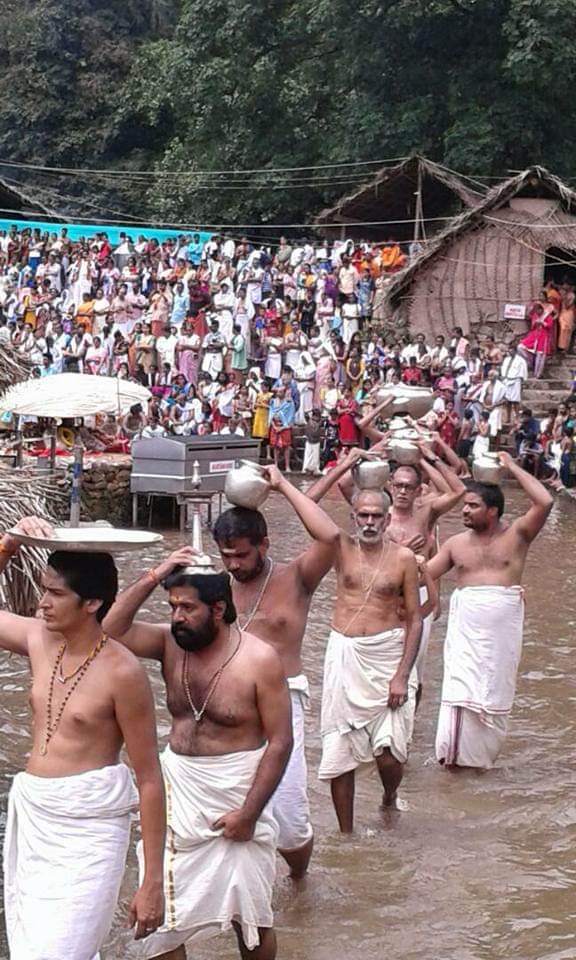
The festival starts with an interesting ritual. People collect water from the River Bavali and place it on the platform where the Swayambhoo Linga is placed. Then a special Hundi kept at a nearby temple will bring here. Women are permitted to enter the premises only after the arrival of this Hundi. On the same day, an ancient sword which is worshiped at Muthireri Kavu Temple in Thavinjal village of Wayanad will be brought here. It is believed that Lord Shiva killed Daksha using this sword. This 27-day festival is considered as pious as Daksha Yaga.
As per the legend, all the gods and goddesses were present during Daksha Yaga and hence the presence of all will be here also during this festival. This festival is also considered as a meeting point of Shaiva, Vaishnava and Shaktheya community. On a particular day, a priest from the nearby Vaishnava family will perform “Alingana Pushpanjali” on the Linga to commemorate the hugging of Vishnu to console Shiva on the demise of his beloved Sati Devi.


Saturday, April 1, 2017

Legend of Thrissur Vadakkumnatha Temple

Thrissur pooram is a grand festival celebrated at thrissur vadakkumnatha temple
No introduction is needed for Thrissur Pooram, the grand festival which has become the symbol of Kerala culture and tradition. Procession of caparisoned elephants, the mind-boggling performance by hundreds of drum artists, and the sparkling fireworks of Thrissur Puram attract people from across the globe. This world-famous celebration is being organized at Thrissur Vadakkumnatha Temple every year.
The legend behind Thrissur Pooram and various rituals and customs related to the Puram festival will be discussed in another article. This is exclusive to talk about the legend behind the temple.
As told in many articles in this blog, Kerala has been carved out from the ocean by Lord Parasurama, the sixth incarnation of Lord Vishnu and he donated the entire land to Brahmins as a solution to escape from the clutches of the sin of murdering his own mother.
After donating the land, Lord Parasurama visited Kailash. His intention was to seek the blessings of Lord Shiva for the people of Kerala. He requested the Lord to come to Kerala and to stay back there to protect the land and its people. Pleased with the devotion of Parasurama, Lord Shiva agreed. As soon as Parasurama left Kailash, Lord Shiva, along with his disciples and his companion Vrishabha started their journey to Kerala.
On the way, they traveled through a dense forest. The forest was so dense that even the sun rays will not enter inside even during mid-noon. All types of wild animals were enjoying a free life inside and the cruel animals became calm and bowed down on their knees as soon as they saw the lord traveling through the forest.
sree moolasthanam at thrissur vadakkumnatha temple

In between, they reached an open place, where there was a banyan tree standing alone. Many small birds were taking shelter on its branches and many small animals were eating the grass-grown beneath the tree. It was dusk and the birds, who have returned to their nestles after a long day’s flying in search of food started humming praises of Lord Shiva. Cows and rabbits enjoyed the song by moving their heads to both sides. A group of peacocks appeared there from nowhere and started dancing to the tune. Lord Shiva loved to be there in that serene atmosphere.
Understanding his master’s thoughts, Rishabha stopped there and the lord got down from Rishabha and sat beneath the banyan tree. This Banyan tree was believed to be there at the place which is known as “Srimoola Sthanam”. Even now there is a banyan tree there and the devotees will pay their respect there before entering the temple.
Parasurama came to know about the incident and he rushed to the spot. He constructed a temple in the open place near the banyan tree and consecrated the Idol inside it. He removed the power of Vishnu from it and placed it in a different sanctum sanctorum beside the one where the Shiva Linga has been placed. Then the divine power started emitting from both Vishnu and Shiva. Parasurama, blended both the divine powers with his tantric power and placed in another sanctum sanctorum in between the two and called it as Lord Sankaranarayana (Having power of both Shankara or Shiva and Narayana or Vishnu).
vadakkumnatha temple is situated in the heart of Thrissur city in Kerala

After a few days, Parasurama observed the divine power of Goddess Durga on the eastern side of the temple. He constructed one temple and consecrated Devi inside that. He also constructed another small temple on the northern side of the temple and placed Lord Vettakkorumakan (believed to be a partial incarnation of Lord Vishnu) for the protection of the temple.
It is believed that Jagad Guru Adi Shankara attained salvation at this temple. The legend says that after conquering the Gyan pita by defeating all scholars, he returned to his native place Kaladi and on the way back he visited Thrissur Vadakkumnatha Temple. He spent some days here. It is believed that he wrote the famous “Vishnu Padadi Keshasthavam” when he was here. One evening he was writing the 43rd of the line of the book. As he wrote the word “Padma” he breathed his last breath and attained salvation. It happened at Srimoola Sthanam. That is another reason for many to believe that Shankaracharya was a partial incarnation of Lord Shiva.
Ashwathama, son of Drona is an immortal being who did not have death. It is believed that he is visiting this temple regularly to get the blessings of Lord Shiva.


Friday, November 28, 2014

Legend of Thirunelli Punarjjani Guha, The Cave of Re-Births

According to Hinduism, the ultimate salvation is when you will not have to take birth on this earth. In Palakkad district of Kerala, there is a cave which will provide salvation if you creep in through it. Located about six kilometers northeast of the famous Thiruvilwamala Temple, this cave attracts hundreds of devotees. However, it is not possible to creep in through the cave every day. Only on an auspicious day (Ekadashi or Malayalam month Vrischikam), devotees gather here to perform the serene ritual. Although many women devotees will visit this cave, they will not creep in through it. Only men are performing this act.
One will have to walk about a kilometer through the steep hillocks filled with sharp rocks and bushes to reach here. Although there are thick bushes around this cave, it is a matter of surprise that no reptiles are found here.

The rituals start with the performance of a special pooja at the cave face by the priest of the nearby temple. Then he will take a bath in the small spring near the cave which is called “Papa nashini” or the destroyer of all sins. He will creep into the cave first. Then the devotees follow him after taking a bath in the “Papanashini”.
The opening of the cave is quite large enough that a man can enter inside by walking, but as he keeps on moving, the height of the cave will gradually decreases and at first, he will have to kneel down and then to crawl. As he reaches the end of the cave he will have to lie down on the floor with on his back and to move slowly. Here the floor is a bit wet and the entire cave will be in total darkness. One will have to catch hold of the legs of the person who is moving in front of him to move in the right direction.
At the end of this struggle, the light will be seen from the opening on the other end of the cave which will bring immense pleasure in the minds of devotees. Once the journey through the cave is completed, it is believed that all your sins are being pardoned. In other words, from then onwards, you will be leading a new life without any sins. In that way also the word “punarjjani” or re-birth which has been given to this cave is meaningful.

The legend behind this cave and this ritual go back to the period of Parasurama, the sixth incarnation of Lord Vishnu. He lost his peace of mind with the guilty feeling of killing many Kshatriyas and his own mother. In order to escape from the clutches of those sins, he underwent a penance in the forest nearby this cave. During that time, it is believed that he had crept in through this cave one hundred and eight times and thus he got relieved from all his sins. This myth about the cave leads hundreds of devotees on a particular day every year to this cave.