Kottiyoor Shiva Temple is one of the most prominent Shiva
Temples in Kerala. Although its original name is Vadakeswaram Temple, it is
most popularly known as Kottiyoor Temple due to its proximity to the Kottiyoor
Village. There are two temples located on either side of the River Bavali. The
one on the Eastern bank is known as Ikkare kottiyoor (Kottiyoor on this bank)
and the one on the western bank is known as Akkare Kottiyoor (Kottiyoor on that
bank). Ikke Kottiyoor will be open all the year for worship when the Akkare
Kottiyoor will be open only for 27 days every year during the festival season.
The Kottiyoor Pilgrimage during these 27 days is an important thing for devotees.
This place is known as the origin of Shakthi Peethas and also the one and the
only place on the planet earth where you will get protected from the evil
effects of Kaliyuga.

What is Shakthi Peethas
King Daksha was not in a mood to send his daughter Sati in
marriage to Lord Shiva but that could not change the minds of Sati. Lord Shiva
and Sati got married against the will of her father Daksha Prajapati and it
left vengeance in the minds of Daksha. Hence, he did not invite Lord Shiva when
he organized a Yagna where he invited all other gods and goddesses. He did it
purposefully to insult Lord Shiva. Though he took it lightly, Sati Devi could
not. She went directly to the Yagnashala and asked her father why he did not
invite her husband. Furious Daksha started insulting Shiva describing him as a
barbarian and naïve. She just could not digest those words and committed
suicide there itself.
Hearing the news of his beloved wife’s suicide, Lord Shiva
arrived at the venue and forced himself inside the yagna shala. Nobody and none
in the universe could bar the furious lord. He killed Daksha. However, he could
not contain his fury just by killing Daksha. He took out the body of his
beloved on his shoulders and started Thandava Dance. Heatwaves have started
emitting from the body of Shiva which became unbearable for the living things
in the universe. Seeing the destruction of the universe, Lord Vishnu appeared
there and cut the body of Sati Devi into fifty-one pieces with his Sudarshan
Chakra. Each piece fell at different places and these places became serene
places where a devotee can converse directly with the divine power of Ma Sati.
These places are known as Shakthi Peethas.

Kottiyoor, the place where Daksha organized his Yagna
It is believed that Daksha organized his Yagna at Kottiyoor.
He started his yagna on a Vishakham star day but could not complete it as he
was killed by Lord Shiva. Later Lord gave life back to Daksha on the request of
Lord Brahma and went back to the Himalayas to undergo penance. Years have
passed and eras have passed. The place became a dense forest where the tribal
known as Kurichyaas used to inhabit. One day a Kurichya youth rubbed his arrow
over a piece of rock to sharpen it and suddenly blood started oozing out from
the rock.
Hearing the news, the Kurichya community leaders gathered at
the place, and upon the advice of an elder, they approached an old Brahmin
staying in a nearby village. He came there and inspected the rock. Suddenly he
felt the presence of divine power in it. He summoned the village astrologer.
Astrologer came and examine various possibilities. Finally, he identified the
power as of Lord Shiva and the old Brahmin performed some immediate rituals
with Koovala (Crataeva Religiosa) leaves.
Later, it has been confirmed that there is the presence of
Sati Devi also. It has been found at the present day “Ammarakalu Thara”, a
lifted piece of rock near to the Swayambhoo Linga. It is believed that Sati
Devi committed suicide at this place. As it is barred to construct a temple based
on some religious principles, only makeshift temples will be constructed during
the festival seasons here. Another interesting fact is that the devotees can
visit this temple only during the 27-day festival season which starts on the
Swathi star of Malayalam month Idava.
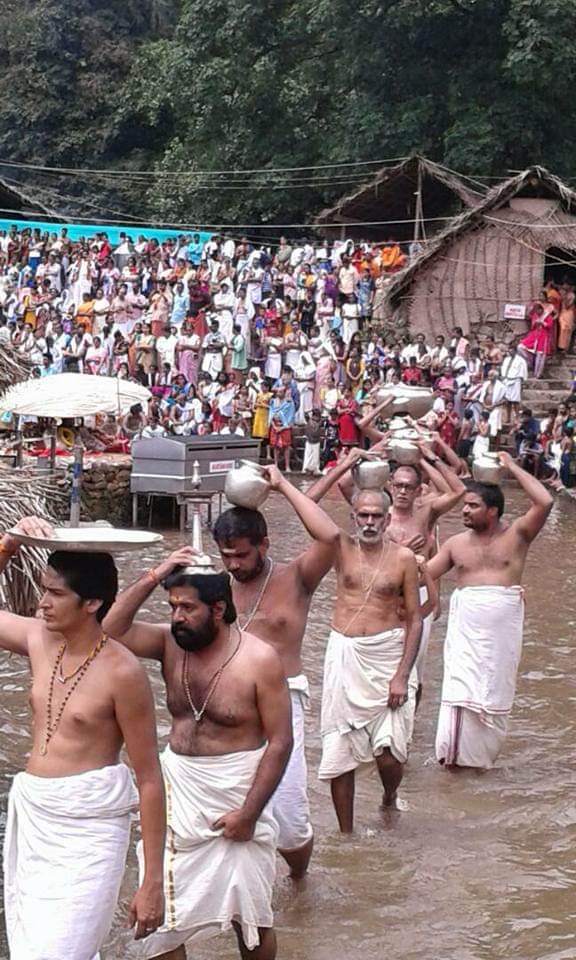
Kottiyoor Temples on Either Side of River Bavali
Whatever we mentioned earlier is about “Akkare Kottiyoor, or
the Kottiyoor Temple on the eastern bank of the River Bavali. There is another
temple on the western bank which is called Ikkare Kottiyoor or Thricherumana
Temple. The idol in this temple has been consecrated by the great Sage
Parasurama. The intention of this was to facilitate devotees to worship Lord
Shiva the entire year whereas they can do the same on the other the temple during
the festival seasons. Later Jagadguru Adi Shankaracharya fixed different types
of rituals to be performed in both these temples. When Shankaracharya visited
this place, it was not the festival season and hence he has not crossed the
river to visit Akkare Kottiyoor. He designed the rituals for Akkare kottiyoor
from the temple located on the other side of the river.
It is believed that Lord Brahma and Vishnu are also present
here inside the shrine. Hence, the Kali, (The figure that represents Kaliyuga)
promised Parasurama that he will never enter inside the temple. That is the
importance of this temple. This is the only place on the earth where the
devotees will get protection from the evil effects of Kaliyuga.

Kottiyoor Pilgrimage
Pilgrimage to Akkare Kottiyoor will be during the 27 days of
the festival and it starts with the Swathi star of Idavom (Malayalam month.
Pilgrimage to Akkare Kottiyoor witnesses the participation from all classes of
the Hindu community. In reality, each community has designated with bringing
some specific materials which are used in different rituals being carried out
in this temple. This duty has been allocated by the Royal Family of Pazhashi
King.
As mentioned earlier, there is no permanent temple structure
here and temporary structures will be constructed during the festival season.
The right to mark different places for different deities lies in people from
the Asari community whereas the right to perform the first Abhisheka is on the
Kurichya community chief. Umbrellas made with palm leaves will be placed at
different Devasthanas and the right to bring these umbrellas is of the people
belong to the Kaniya community. The ghee for Abhishekam will be brought by the
people belonging to the Nair community and the coconuts by Theeya community.
The wicks to be used in the lamps will be brought by the people from the
Chaliya community. People belonging to each community will bring the designated
material even from far away places.
The festival starts with an interesting ritual. People
collect water from the River Bavali and place it on the platform where the
Swayambhoo Linga is placed. Then a special Hundi kept at a nearby temple will
bring here. Women are permitted to enter the premises only after the arrival of
this Hundi. On the same day, an ancient sword which is worshiped at Muthireri
Kavu Temple in Thavinjal village of Wayanad will be brought here. It is
believed that Lord Shiva killed Daksha using this sword. This 27-day festival
is considered as pious as Daksha Yaga.
As per the legend, all the gods and goddesses were present
during Daksha Yaga and hence the presence of all will be here also during this
festival. This festival is also considered as a meeting point of Shaiva,
Vaishnava and Shaktheya community. On a particular day, a priest from the
nearby Vaishnava family will perform “Alingana Pushpanjali” on the Linga to
commemorate the hugging of Vishnu to console Shiva on the demise of his beloved
Sati Devi.


