Showing posts with label trichur pooram. Show all posts

Saturday, April 1, 2017

Legend of Thrissur Vadakkumnatha Temple

Thrissur pooram is a grand festival celebrated at thrissur vadakkumnatha temple
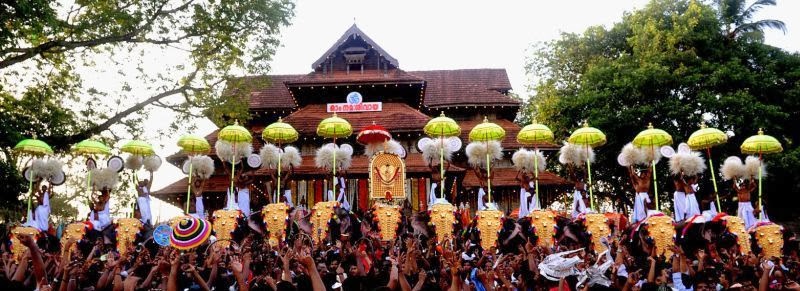
No introduction is needed for Thrissur Pooram, the grand festival which has become the symbol of Kerala culture and tradition. Procession of caparisoned elephants, the mind-boggling performance by hundreds of drum artists, and the sparkling fireworks of Thrissur Puram attract people from across the globe. This world-famous celebration is being organized at Thrissur Vadakkumnatha Temple every year.
The legend behind Thrissur Pooram and various rituals and customs related to the Puram festival will be discussed in another article. This is exclusive to talk about the legend behind the temple.
As told in many articles in this blog, Kerala has been carved out from the ocean by Lord Parasurama, the sixth incarnation of Lord Vishnu and he donated the entire land to Brahmins as a solution to escape from the clutches of the sin of murdering his own mother.
After donating the land, Lord Parasurama visited Kailash. His intention was to seek the blessings of Lord Shiva for the people of Kerala. He requested the Lord to come to Kerala and to stay back there to protect the land and its people. Pleased with the devotion of Parasurama, Lord Shiva agreed. As soon as Parasurama left Kailash, Lord Shiva, along with his disciples and his companion Vrishabha started their journey to Kerala.
On the way, they traveled through a dense forest. The forest was so dense that even the sun rays will not enter inside even during mid-noon. All types of wild animals were enjoying a free life inside and the cruel animals became calm and bowed down on their knees as soon as they saw the lord traveling through the forest.
sree moolasthanam at thrissur vadakkumnatha temple

In between, they reached an open place, where there was a banyan tree standing alone. Many small birds were taking shelter on its branches and many small animals were eating the grass-grown beneath the tree. It was dusk and the birds, who have returned to their nestles after a long day’s flying in search of food started humming praises of Lord Shiva. Cows and rabbits enjoyed the song by moving their heads to both sides. A group of peacocks appeared there from nowhere and started dancing to the tune. Lord Shiva loved to be there in that serene atmosphere.
Understanding his master’s thoughts, Rishabha stopped there and the lord got down from Rishabha and sat beneath the banyan tree. This Banyan tree was believed to be there at the place which is known as “Srimoola Sthanam”. Even now there is a banyan tree there and the devotees will pay their respect there before entering the temple.
Parasurama came to know about the incident and he rushed to the spot. He constructed a temple in the open place near the banyan tree and consecrated the Idol inside it. He removed the power of Vishnu from it and placed it in a different sanctum sanctorum beside the one where the Shiva Linga has been placed. Then the divine power started emitting from both Vishnu and Shiva. Parasurama, blended both the divine powers with his tantric power and placed in another sanctum sanctorum in between the two and called it as Lord Sankaranarayana (Having power of both Shankara or Shiva and Narayana or Vishnu).
vadakkumnatha temple is situated in the heart of Thrissur city in Kerala

After a few days, Parasurama observed the divine power of Goddess Durga on the eastern side of the temple. He constructed one temple and consecrated Devi inside that. He also constructed another small temple on the northern side of the temple and placed Lord Vettakkorumakan (believed to be a partial incarnation of Lord Vishnu) for the protection of the temple.
It is believed that Jagad Guru Adi Shankara attained salvation at this temple. The legend says that after conquering the Gyan pita by defeating all scholars, he returned to his native place Kaladi and on the way back he visited Thrissur Vadakkumnatha Temple. He spent some days here. It is believed that he wrote the famous “Vishnu Padadi Keshasthavam” when he was here. One evening he was writing the 43rd of the line of the book. As he wrote the word “Padma” he breathed his last breath and attained salvation. It happened at Srimoola Sthanam. That is another reason for many to believe that Shankaracharya was a partial incarnation of Lord Shiva.
Ashwathama, son of Drona is an immortal being who did not have death. It is believed that he is visiting this temple regularly to get the blessings of Lord Shiva.


Monday, February 3, 2014

Vadakkunnathan Temple and Thrissur Pooram


Vadakkunnathan Temple in Trichur (Presently Thrissur) is more famous for the festival associated with the temple, Trichur Pooram. Procession with caparisoned elephants accompanied by the traditional drumbeats is the most attractive among various rituals during Pooram. ‘Kudamatam’ or changing the decorative umbrellas placed on the elephants participating in the procession is another attraction. Fireworks in the early morning also attract many people to this temple during the Pooram day.
A scene from Trichur Pooram
The deity in this temple, Lord Shiva in the form of Linga is believed to have been installed by Parasurama. The legend goes back to the creation of Kerala from the ocean. Parasurama went around the Bharatha Khanda and exterminated the kshatriyas 21 times. To get rid of the sin of killing so many people he conducted a special yagna and at the end of it, he decided to donate some fresh land to the Brahmins who participated in the yagna. He asked Varuna, the God of the sea to part with some land for this purpose and he agreed. Varuna told Parasurama to throw his ax from the top of Gokarna Hills (presently in the state of Karnataka) into the sea which was touching the foot of Gokarna on those days. He promised that he will withdraw from place expanded until the point where the ax falls.
Accordingly, Parasurama threw his ax into the sea and it fell on the pint where the present-day Kanyakumari situates. Varuna withdrew from there thus forming a fresh piece of land which is now called Kerala. After creating the land, Parasurama went to Mount Kailash to visit Lord Shiva. Parashurama was an ardent devotee of Lord Shiva and Shiva too respected his devotee very much. When asked about his indention for coming, Parasurama narrated the entire story and requested him to come and take abode in the fresh piece of land created by throwing ax. Shiva cannot reject the plea of an ardent devotee along with Goddess Parvathy, Ganesha and Muruka followed Parasurama.
When they reach at the spot where the present-day Trichur situates, Lord Shiva stopped walking and disappeared. Then Parasurama saw a divine Shiva Linga beneath a huge banyan tree. He started worshiping the same and asked the Brahmins whom he donated the land to worship that linga for their well being.
The practice of worshipping the linga under the tree continued for several centuries. Later Kochi King, under whose jurisdiction Trichur came on those days decided to build a temple and to shift the linga to that temple. The temple, which is an excellent example of the architecture of ancient Kerala, is believed to have built by Perumthachan of Parayi Peta panthirukulam. After the construction of the temple, when the process for shifting the linga started, they faced a great hurdle.
Some parts of the huge banyan tree had to cut to remove the linga from the place where it existed. The chances of falling the branches on the linga were more which should not happen. At that time a Brahmin, who has been taking care of the rituals for the linga so far came out with a unique idea. He agreed to bend above the linga so that the branches will fall on his top only instead of falling on the linga. To the surprise of everyone present there, not a single piece of the branch fell on that Brahmin. The linga has been shifted to the temple and started worshiping as Vadakkunnathan.
Although there are many festivals being celebrated in this temple including Maha Shivarathri, Trichur Pooram is the major festival that attracts visitors from all over the world. When most of the other festivals have legends associated with the concerned gods, Trichur Pooram has nothing. It has been started as a festival of people by the then Kochi King Shakthan Thampuran.
The surroundings around the temple (which is now famous as Thekkinkadu Maithanam) was a dense forest mostly with teak wood. People used to fear to go around the temple as there were many wild animals inside the forest. Besides, many antisocial elements also used this dense forest as their den. Shakthan Thampuran ordered to cut all the trees and thus to clear the ground so that people can move without any fear.
A legend associated with this incident says that when he started cutting down the trees, the oracle of the nearby Paramekkavu Devi Temple came there are asked him to stop the work. The oracle, who is believed to have evoked the divine power of Devi told the king that the forest is her father’s beard and it should not be cut down. Shakthan Thampuran, who was a daring king asked the oracle where she and her father was when the Tipu came there and looted many temples. This made the oracle angry and he started striking his sword on the forehead, a usual practice of oracles to show that the divine power has entered in them. Then Shakthan Thampuran told the oracle that oracle’s word is not sharp and better use his sword. Saying this, the king put his sharp sword on the head of the oracle and cut him into two vertical pieces.
After clearing the forest, he asked the local people to celebrate the pooram once in a year and everyone should contribute to make it a big festival. He instructed many practices that are to be followed during Trichur Pooram. Now the festival has become a festival of people of Kerala and it is being celebrated every year from April 14th to May 15th.