Thursday, June 2, 2022

Kashi Vishwanath Temple


Kashi Temple


Shri Kashi Vishwanath temple is one of the holiest temples in India and is one of the twelve Jyotirlingas of Lord Shiva. The temple is located on the western banks of the holy river Ganga in the city of Varanasi, Uttar Pradesh. Lord Shiva is also called Viswanath or Vishweshwar and that is why the temple came to be known as Kashi Vishwanath Temple.

Legend of the Temple


Legend of the temple is related to the formation of Jyotirlingas or the radiant symbol of Lord Siva. Once there was an argument between Lord Brahma and Lord Vishnu regarding the supremacy. They approached Lord Siva to find out the right answer. 


Then Siva appeared in front of them in the form of a huge pillar of light and asked them to find the end of it. Both Vishnu and Brahma started their journey. When one went upwards to find the top end the other went downward. Even after intense efforts, they could not find the end.


Lord Vishnu came back to Lord Shiva and expressed his inability to find the end but Brahma lied that he saw the end. Angry with the dishonesty of Lord Brahma, Siva cursed him that no human being will worship him instead they all will worship Lord Vishnu. Then the pillar of light has been divided into twelve parts and placed at different places. One among them is in Kashi.


Manikarnika ghat is an important place included in the pilgrimage to Kashi. This place has an important place in Shakteya worship (worship of goddess). When Daksha conducted a huge yagna, all gods were invited except Lord Shiva. As Shiva married Sati, daughter of Daksha against the wishes of Daksha, he was angry with Shiva. However, Sati took it as an insult and went to the Yagasala to question this injustice. 


There Daksha insults his daughter and depressed with the act of her father Sati committed suicide by jumping into the holy fire. Furious Shiva went to Daksha and killed him. On the way, he is believed to have come to Kashi and spent some time here. It is believed that he entered Kashi through this Manikarnika ghat. 


It is believed that if a devotee can see the linga here, he will get salvation


History of the Temple

Although there is mention about this temple in many epics including Skanda Purana, there is no written evidence to prove when the temple has been built for the first time. The written history of the temple starts with the attack on the temple by the army of Mohammed Ghory in 1194 CE. His commander Qutb-ud Din Aibak defeated the king of Kanauj and destroyed the temple entirely. Then it has been reconstructed by a Gujarati merchant from 1211-1266. 


Again the temple has been destroyed during the period of Ibrahim Lodhi and Raja Mann Singh tried to rebuild the temple during the period of Akbar, the Mughal Emperor. However, Hindus boycotted him as he allowed Mughals to get into marriage with his family members. Later Raja Todarmal rebuilt the temple at the original spot with the financial aid of Akbar. 


Then in 1669, Aurangzeb destroyed the temple completely and constructed the Gyanvapi Mosque at the place. For a long time, the temple has not been reconstructed. It was in 1742, Maratha Ruler Malhar Rao Holkar attempted to demolish the mosque and to construct the temple there. However, the plan has not been materialized due to the resistance from the Nawab of Lucknow as Kashi was under their jurisdiction then. Again in 1750, Maharaja of Jaipur planned to purchase the land there and to reconstruct the temple. He too failed in materializing the dream. 


Then in 1780, Ahilyabai Holkar, daughter in law of Malhar Rao Holkar constructed the present-day temple near to the mosque. Later during 1828, a low roofed colonnade with more than forty pillars was built by Baija Bai, the widow of Maratha ruler Daulat Rao. 


Rituals at the Temple


The temple opens at 2:30 am and the following rituals are conducted :

● 3:00 - 4:00 am Mangala Aarti is held

● 4:00 - 11:00 am General Darshan is allowed. 

● 11:30 am - 12:00 pm Bhog Aarti is done. 

● 12:00 - 7:00 pm Devotees are free for Darshan. 

● 7:00 - 8:30 pm Sapta Rishi Aarti is held

● 8:30 - 9:00 pm Darshan is allowed. 

● 9:00 - 10:30 pm Bhog Aarti. 

● 10:30 - 11:00 pm Shayan Aarti. 


The temple closes at 11:00 pm. 


How to reach


By Air - Indian airlines have a flight to Babatpur airport that is 22kms from Varanasi and 30kms from Sarnath.

By Train - Varanasi Junction station 6kms from the temple. Mughalsarai station is 17kms travel to the temple. Maduadin station is closer with 4kms distance and the Varanasi city station is just 2kms away. 

By Road - Varanasi is on the NH2 that is found on your travel from Calcutta to Delhi. 


Rules of the Temple 

● Devotees are not allowed to carry cellphones, cameras, metal items, cigarettes and lighters into the temple.

● The decent dressing is required. 

● The police conduct frequent frisking and devotees must oblige.

● Footwears are not allowed. 


How to Reach

Nearest Airport: Varanasi. 

Distance from Airport to Temple: 24.9 Km


Nearest Railway Station: Kashi and Varanasi

Distance from Kashi Railway Station to Temple: 4.9 Km

Distance from Varanasi Railway Station to Temple: 4.6 Km


Saturday, June 6, 2020

Tharananalloor, The Last Word in Kerala Tantric Rituals


kerala tantric

As told many times earlier, Kerala is being created by Lord Parasurama. After the creation of the land, he brought several people from other parts to live here. He has constructed many temples across Kerala and designated two Brahmin Families to take care of the Tantric part of the temple activities. Tharananalloor and Thazhaman were those two families. There is an interesting myth about how those names have come to exist.
Lord Parasurama was sitting on the banks of Holy River Pamba. At that time heads of both these families appeared on the other side of the river. Parasurama asked both of them to come near to him immediately. Actually, he intended to check their expertise in Tantra. When one of them crossed the river by walking over the waves, the other one crossed it by walking over the bed of the river. When the river stood standstill to enable the great tantric to cross by walking over it, it paved way for the other by keeping the water away from his way. The one who crossed the river by walking over it came to be known as Tharananalloor as he crossed it walking over it. The other one who walked over the river bed (Thazhe mannu in local language Malayalam means the sand beneath) came to be known as Thazheman.
Pleased with their expertise, Parasurama allotted the right of Tantra in all Sastha Temples to Thazhaman family and that of Devi temples to Tharananalloor family. As there were temples of other gods, these have been divided among them equally.  However, Tharananalloor Namboothiri, as the head of the family used to be known, had the rights of Tantra in different temples even outside Kerala too. He had the right to perform tantric rituals in the famous Madhura Meenakshi Temple in Tamil Nadu. He used to perform the rituals during the Kalabham Ceremony which has been conducted every year.
Once the administration of the temple has fallen in the hands of some new generation people who were not religious as much their predecessors were. They raised the necessity of performing the Kalabham ceremony every year after spending a huge amount. When the Tharananalloor Namboodiri came that year to perform rituals, the temple administrator demanded that he should be able to see Goddess Devi in person.
Namboodiri tried to deviate his attention to other things so that he will not insist on it again. But the administrator stuck to his demand. Then Namboodiri told him that he can peep through the temple doors when Namboodiri performs the rituals after closing the doors. Namboodiri also warned him that he will not be responsible for any unwanted things if something happens. Administrator agreed.
In the evening, when Namboodiri entered the temple for performing tantric rituals after closing the door, the administrator came in front of the door and peeped through the gap in between the two doors. He saw the ferocious form of Devi through the gap and fell down unconscious. Hearing his loud cry other people from the temple office came there and took the man away to the hospital. Although the hospital authorities tried their level best, he lost his eyesight and had to live as blind for the remaining life. Namboodiri did not know all these happenings and when he came out, people narrated him the entire incidents. He turned towards the sanctum sanctorum and told loudly.
“Oh, Goddess Ma, Now I am performing the rituals here. I am not sure whether my predecessors can do it or not. So I am surrendering my right to perform the rituals in this temple.” Thus Tharananalloor family ceased to be the Tantri of Madhura Meenakshi Temple.
There are many stories about the performances of different Tharananalloor Namboodiripads, who were the heads of the family at different periods. Since it will consume too much of space, only one such story is being narrated here.
Once, the Namboodiri, then head of the family went to have a bath in the family pond. It was early in the morning and there prevailed silence in the atmosphere. Suddenly he heard a loud cry from the other side of the pond and sent his servant to enquire about it. The servant returned and told Namboodiri that Neelakandan, who was residing on the other side of the pond died due to snakebite and it was the cry of his wife and children they heard. Then Namboodiri told his servant that Neelakandan has not died and ask him to bring the body there.
Neelakandan’s family members brought the body to the pond side. He asked them to keep the body in an open space. Then He waited near the body holding a small stick in his hand. Hours have passed and nothing happened. Villagers started gathering at the place and there were some rationalists also among them. They started kidding Namboodiri. Still, he waited there holding the stick and did not try to answer anybody’s queries.
After a few hours, a snake came there and raised its hood as if extending pleasantries with Namboodiri. Immediately Namboodiri asked his servant to bring milk and coconut water in two separate bowls. They have been brought and kept on both sides of the body of Neelakandan. After that, Namboodiri turned towards the snake and told it.
“Take it back.” The snake went near the body of Neelakandan and bitted once again on his legs. It kept its teeth for quite some time and then came near Namboodiri. Namboodiri told it not to worry as he has kept milk there, it can dip its head in it. The snake did the same and to the utter shock of the crowd gathered there, the color of the milk turned blue. Namboodiri again instructed him to take back the poison and the snake obeyed it. This time Namboodiri asked the snake to dip the head in the bowl of coconut water and that too turned blue. When the snake finished sucking poison from the body of Neelakandan, Namboodiri broke the stick he was holding in his hand. Everybody presented there surprised to see the body of the snake get breaking into two pieces. And adding more glory to the occasion, Neelakandan Woke up as if he was asleep.
By that time, Neelakandan’s relatives have made all arrangements for his cremation. The body of the snake has been cremated at that place and Namboodiri performed all rituals standing in the place of the snake’s son. He even observed the Deeksha (A ritual to be observed by the eldest son after the death of father) for a year.


Thursday, June 4, 2020

Temple for Vaidyanathan who Cures Epilepsy and Many Other Chronic Diseases


Lord Shiva has been worshiped in many forms and one among them is Vaidyanathan. The concept of Vaidyanathan is related to the curing of chronic diseases. It can be equated with the Dhanvandari concept of Lord Maha Vishnu. There is a temple dedicated to this Bhava of Lord Shiva in Kerala and that is Puramundekkad Shiva Temple. It is also known as Porandekkad Shiva Temple.
If you go to previous pages of this blog, you will come across the legend related to the formation of Kerala. It is believed that Parasurama, the sixth incarnation of Lord Vishnu created this land. After creating the land, he had constructed 108 Shivalayas (Temples of Lord Shiva) to protect the land from evil spirits. Puramundekkaad or Prandekkad Shiva Temple is one of them. 

There is one another legend saying the installation of the idol has been done by Hara Maharshi.
Years have passed since then and the temple constructed by Parasurama got abandoned. People who used to reside in this locality have migrated to different other places and the area has become a thick forest. People from the villages used to go inside the forest to collect wood logs for their cooking purpose. Once, such a group of villagers who went inside the forest witnessed a flame of fire in the atmosphere. It was moving slowly and the villagers followed it to reach a place where a one-foot tall Shivalinga was found. Surprised with it the villagers collected flowers from the nearby plants and worshiped the god with devotion. They offered a few plantain fruits also.
puramundekkad shiva temple

Later the nearby villagers gathered there and constructed a temple for Lord Shiva. Here in this temple, Lord Shiva is in the Bhava of Vaidyanathan. As per the Hindu belief, epilepsy is caused by a Yaksha with the name Apasmaara. Here, the divine concept is that the Vaidyanathan is performing Thandava Dance upon this Yaksha. In other words, the Yaksha is in total control of Lord Shiva here. Hence, devotees believe that epilepsy and other chronic diseases can be cured by this power.

Another interesting fact is the offering of plantain fruit. It is a practice for the people residing in the nearby villages to offer the first product from their plantain cultivation to God. When you give it, the same will be taken inside the temple and will be offered to the Lord. After that, it will return to you but the sweetness will be lesser then. It is believed that Lord Shiva is accepting the sweet nectar inside the fruit.

This ancient temple is located in the Ponnani Taluk of Malappuram district. It is a swayambhoo linga and is facing towards the east. Unlike in other Shiva temples, there are two Nandi idols are being worshiped here. Apart from the main deity, Lord Vishnu, Ganapati, Dakshinaamoorthy, Ayyappan, Sri Krishna is also worshiped here. The temple is just 2 km away from Edappal Bus stand.

Tuesday, June 2, 2020

Thiruvarppu, the Temple that Opens first in India


It is a common practice to open temples in the early morning. Hence it may be difficult to say which temple opens first in India. No, doubt about as there is only one answer for this, it is none other than Thiruvarppu Sri Krishna Temple at Thiruvarppu, in the Kottayam district of Kerala. Every day, it opens at 2 a.m. and surprisingly it will not be kept closed during eclipses when all other temples throughout India will be closed as per the tradition.
Thiruvarppu Sri Krishna Temple

Legends behind Thiruvarppu Sri Krishna Temple

There is more than one legend behind this temple and all of them are related to the recovery of a Krishna Idol with four hands attached to a copper vessel which is called Uruli or Varppu in local language Malayalam. And all the legends connect this temple to the period of Mahabharata. It is believed that the Pandavas used to carry an idol of Lord Krishna during their stay in the forests (Vanavasa). Their Vanavasa ended up here in Thiruvarppu and before going in disguise (Ajnjatha Vasa) the villagers request the Pandu brothers to leave behind the idol there so that they can worship it as their village deity. They agreed and handed the same to the head of the village.
The villagers constructed a temple and consecrated this idol of Sri Krishna with four hands. To the utter surprise of the villagers, they had to face many hardships after starting worshiping the idol. They approached an eminent astrologer and he told them that they are not worshipping the idol properly. Since they are not able to meet the level of devotion Pandavas had, they cannot worship it properly in the future also so, he advised them to immerse it in the nearby lake. They did accordingly.
Years have passed. Once, Vilwamangalam Swamiyar, a great sage who was a tool in consecrating idols in many Temples in Kerala was traveling on a boat. Suddenly the boat stopped moving and the rowers though tried their best could not move even a bit further. As told by the Swamiyar, one of the rowers dived deep in the lake and found an idol of Sri Krishna. Swamiyar took custody of the idol and started his travel.
Thiruvarppu Srikirshna Temple

In between, he felt to have a bit rest and asked the rowers to anchor the boat near some good place. They did accordingly. Vilwamangalam Swakiyar got down from the boat and went near a tree to have rest. He had the idol with him. He kept the idol on a copper vessel (Varppu or Uruli in local language Malayalam) and kept it near him before he took a nap. After an hour’s sleep, he woke up. When he tried to pick up the idol, he could not as it got stuck to the soil. Hearing this news, the nearby people gathered there.  The land where Swamiyar took rest, was the property of a person called Kannankari Menon. He announced his consent to give the land for the construction of the temple and requested Swamiyar to consecrate the idol there.
In another legend, it is Padmapada Swamy, a disciple of Sankaracharya who was traveling by boat and he got the idol. It was kept inside Uruli. Then he searched for a place to place and found a temple in a nearby place where no idol has been installed. With the consent of the locals, he placed the idol in that temple.
There is one more variant of the first legend. In that, it is said that a group of fishermen who were catching fish in the sea got the idol but without a vessel. They took it to their village and constructed a temple and installed the idol there. However, many calamities happened in their village after that and hence they threw it back to the sea, and later Villwamangalam Swamiyar got it.

It is Hungry Krishna just after the killing of Kamsa

It is believed that the bhava of Krishna in this idol is that of the first moments after killing Kamsa. Hence, he is very much hungry. That is why the temple is getting opened so early at 2. Am. After opening it the priests will perform Abhisheka. Then after wiping out the water from the head of the idol, they perform a Naivedya (Feeding the deity with his favorite food) After that they will wipe out the rest of the body parts and perform the decorations and other rituals.
Moreover, this may the only temple where the chief priest is provided with the key to the main door of the Sanctum sanctorum and also an ax. This is to break open the door if he finds any problems with the keys. Lord cannot bear the hunger for a long time and it is necessary to open the door at exactly 2 a.m. If necessary, the priest can break open the door at that time. 

Why the temple remains open during eclipse

Unlike other temples in India, this temple will not be closed during eclipses. If it is closed, the lord will feel hungry which he cannot bear. It is believed that once the temple authorities closed the temple during an eclipse. When they reopened it, to their utter shock they saw the decorated belt of the idol slipped down. Fortunately, Vilvamangalam Swamiyar was there during that time and he told the authorities that it happened as the lord is too hungry. Since then, the temple will not be closed during the eclipse.
Thiruvarppu Sri Krishna Temple

Special Features of the Temple

The temple has a special type of drum which is made with bell metal. It is believed that the lord announced the killing of Kamsa by playing this Drum.
The temple festival is being organized every year during the Malayalam month of Medam (April-May). It is a ten-day festival and on the tenth day, the rays of setting sun will enter the sanctum Santorum of the temple.
The usual offerings to god are Milk Payasam, Ghee Payasam, and Appam


Sunday, May 31, 2020

Kottiyoor Temple; the Origin of Shakthi Peethas


Kottiyoor Shiva Temple is one of the most prominent Shiva Temples in Kerala. Although its original name is Vadakeswaram Temple, it is most popularly known as Kottiyoor Temple due to its proximity to the Kottiyoor Village. There are two temples located on either side of the River Bavali. The one on the Eastern bank is known as Ikkare kottiyoor (Kottiyoor on this bank) and the one on the western bank is known as Akkare Kottiyoor (Kottiyoor on that bank). Ikke Kottiyoor will be open all the year for worship when the Akkare Kottiyoor will be open only for 27 days every year during the festival season. The Kottiyoor Pilgrimage during these 27 days is an important thing for devotees. This place is known as the origin of Shakthi Peethas and also the one and the only place on the planet earth where you will get protected from the evil effects of Kaliyuga.
Kottiyur Temple


What is Shakthi Peethas

King Daksha was not in a mood to send his daughter Sati in marriage to Lord Shiva but that could not change the minds of Sati. Lord Shiva and Sati got married against the will of her father Daksha Prajapati and it left vengeance in the minds of Daksha. Hence, he did not invite Lord Shiva when he organized a Yagna where he invited all other gods and goddesses. He did it purposefully to insult Lord Shiva. Though he took it lightly, Sati Devi could not. She went directly to the Yagnashala and asked her father why he did not invite her husband. Furious Daksha started insulting Shiva describing him as a barbarian and naïve. She just could not digest those words and committed suicide there itself.
Hearing the news of his beloved wife’s suicide, Lord Shiva arrived at the venue and forced himself inside the yagna shala. Nobody and none in the universe could bar the furious lord. He killed Daksha. However, he could not contain his fury just by killing Daksha. He took out the body of his beloved on his shoulders and started Thandava Dance. Heatwaves have started emitting from the body of Shiva which became unbearable for the living things in the universe. Seeing the destruction of the universe, Lord Vishnu appeared there and cut the body of Sati Devi into fifty-one pieces with his Sudarshan Chakra. Each piece fell at different places and these places became serene places where a devotee can converse directly with the divine power of Ma Sati. These places are known as Shakthi Peethas.
Kottiyur Temple


Kottiyoor, the place where Daksha organized his Yagna


It is believed that Daksha organized his Yagna at Kottiyoor. He started his yagna on a Vishakham star day but could not complete it as he was killed by Lord Shiva. Later Lord gave life back to Daksha on the request of Lord Brahma and went back to the Himalayas to undergo penance. Years have passed and eras have passed. The place became a dense forest where the tribal known as Kurichyaas used to inhabit. One day a Kurichya youth rubbed his arrow over a piece of rock to sharpen it and suddenly blood started oozing out from the rock.
Hearing the news, the Kurichya community leaders gathered at the place, and upon the advice of an elder, they approached an old Brahmin staying in a nearby village. He came there and inspected the rock. Suddenly he felt the presence of divine power in it. He summoned the village astrologer. Astrologer came and examine various possibilities. Finally, he identified the power as of Lord Shiva and the old Brahmin performed some immediate rituals with Koovala (Crataeva Religiosa) leaves.
Later, it has been confirmed that there is the presence of Sati Devi also. It has been found at the present day “Ammarakalu Thara”, a lifted piece of rock near to the Swayambhoo Linga. It is believed that Sati Devi committed suicide at this place. As it is barred to construct a temple based on some religious principles, only makeshift temples will be constructed during the festival seasons here. Another interesting fact is that the devotees can visit this temple only during the 27-day festival season which starts on the Swathi star of Malayalam month Idava.
Kottiyur Temple festival

Kottiyoor Temples on Either Side of River Bavali

Whatever we mentioned earlier is about “Akkare Kottiyoor, or the Kottiyoor Temple on the eastern bank of the River Bavali. There is another temple on the western bank which is called Ikkare Kottiyoor or Thricherumana Temple. The idol in this temple has been consecrated by the great Sage Parasurama. The intention of this was to facilitate devotees to worship Lord Shiva the entire year whereas they can do the same on the other the temple during the festival seasons. Later Jagadguru Adi Shankaracharya fixed different types of rituals to be performed in both these temples. When Shankaracharya visited this place, it was not the festival season and hence he has not crossed the river to visit Akkare Kottiyoor. He designed the rituals for Akkare kottiyoor from the temple located on the other side of the river.
It is believed that Lord Brahma and Vishnu are also present here inside the shrine. Hence, the Kali, (The figure that represents Kaliyuga) promised Parasurama that he will never enter inside the temple. That is the importance of this temple. This is the only place on the earth where the devotees will get protection from the evil effects of Kaliyuga.

Kottiyur

Kottiyoor Pilgrimage

Pilgrimage to Akkare Kottiyoor will be during the 27 days of the festival and it starts with the Swathi star of Idavom (Malayalam month. Pilgrimage to Akkare Kottiyoor witnesses the participation from all classes of the Hindu community. In reality, each community has designated with bringing some specific materials which are used in different rituals being carried out in this temple. This duty has been allocated by the Royal Family of Pazhashi King.
As mentioned earlier, there is no permanent temple structure here and temporary structures will be constructed during the festival season. The right to mark different places for different deities lies in people from the Asari community whereas the right to perform the first Abhisheka is on the Kurichya community chief. Umbrellas made with palm leaves will be placed at different Devasthanas and the right to bring these umbrellas is of the people belong to the Kaniya community. The ghee for Abhishekam will be brought by the people belonging to the Nair community and the coconuts by Theeya community. The wicks to be used in the lamps will be brought by the people from the Chaliya community. People belonging to each community will bring the designated material even from far away places.
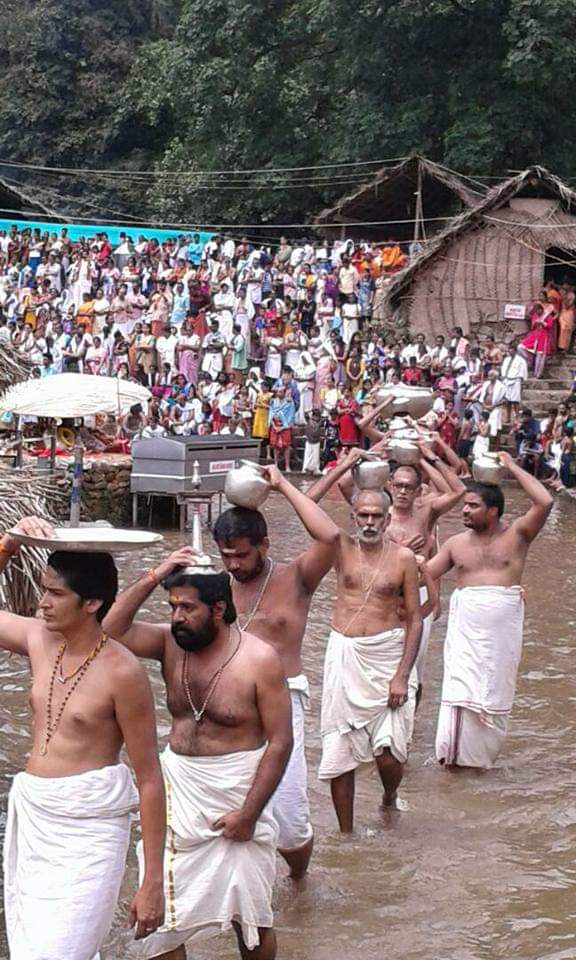
The festival starts with an interesting ritual. People collect water from the River Bavali and place it on the platform where the Swayambhoo Linga is placed. Then a special Hundi kept at a nearby temple will bring here. Women are permitted to enter the premises only after the arrival of this Hundi. On the same day, an ancient sword which is worshiped at Muthireri Kavu Temple in Thavinjal village of Wayanad will be brought here. It is believed that Lord Shiva killed Daksha using this sword. This 27-day festival is considered as pious as Daksha Yaga.
As per the legend, all the gods and goddesses were present during Daksha Yaga and hence the presence of all will be here also during this festival. This festival is also considered as a meeting point of Shaiva, Vaishnava and Shaktheya community. On a particular day, a priest from the nearby Vaishnava family will perform “Alingana Pushpanjali” on the Linga to commemorate the hugging of Vishnu to console Shiva on the demise of his beloved Sati Devi.


Wednesday, December 6, 2017

Another Great Tantric who is not a Brahmin by Birth

Once, the right to perform tantric rituals was rested upon those who were Brahmins by birth. The time and the history have already proved that the status of Brahmin, as mentioned in the Hindu epics cannot be attained by birth. Still many people are reluctant to accept the truth. The effect of mesmerism, which kept generations under the Brahminical rule, may be the reason for such a situation.
Here is a legend of Manakkadan Gurukkal, who was a great tantric and at the same time a great scholar. He was not a Brahmin by birth; still he could master the art of tantra more than many Brahmins could. This great man lived in Karivalloor, in Kannur district in the northern Kerala and was an Ayurvedic physician too.
Many stories of his greatness spread across Kerala and there were many people who sincerely adored him as a personification of God. This created jealous in the minds of many people belonging to upper cast, especially Brahmins. The king of Kolathiri, a princely state existed in Kerala before the independence of India, planned to test Manakkadan Gurukkal’s expertise in Tantra. King planned to put Gurukkal to severe test. King and his cohorts believed that Gurukkal could not pass these tests and so he will get insulted and will run away from his country.
Actually, Gurukkal was undergoing some bad times in his life then; still he could not reject the invitation of King as it was an order. He was sure that he will have to face many hurdles before reaching the palace and even after reaching there. He prayed to his family goddess and then started his journey along with his disciple Puthiyodan Nair.
On those days, travelling was not so easy and they had to travel by walk from Karivalloor and had to cross three rivers before reaching king’s palace. They started their journey. When they reached near the first river, they could no see any boats to cross the river. Otherwise there should be many boats to help the travelers. Gurukkal understood that it was a test put up by the king. He did not speak anything, instead hold the hands of his disciple and asked him to close his eyes. Then, Gurukkal performed a particular tantric ritual known as “Jalasthambham” by which the water in the river stood still. Both of them walked over it and reached the other bank. Same thing happened with other two rivers, Pazhayangadi River and Valarpattanam River too. Finally they reached the palace.
The doors were closed when they reached Palace and there were no security persons too. It was another test. However, Gurukkal, did not taken aback. He caught hold of his disciple’s hand tightly and entered inside the palace with his tantric power. He went through the wall without breaking it. Once they reached inside the palace, Gurukkal saw many persons sitting on similar chairs with similar roayal dress. As he did not see the king before, everybody thought that he will get confused and will bow in front of some one among those. But Gurukkal identified the real king and bowed in front of him.
Then the king invited him for lunch. All others invited were belonging to upper casts and as per the system prevailed on those days, Gurukkal will have to take out the banana leaf which he used as the plate to have lunch. At the same time, those belong to the upper cast will not have to take it out as the servants will do for them. Sensing the insult well in advance, Gurukkal requested to serve the food on the leaf of cucumber and the same has been agreed. As the lunch is over, the leaf too disappeared. Thus, Gurukkal won all the tests.
On that evening King and his people enjoyed various performances done by Gurukkal. After finishing the performance, King gave him a list and asked to arrange all the forty “Theyyams” (A folk art form) by night. It was quite impossible for anybody to arrange all those theyyams within a short period, still Gurukkal did it even without moving out of the palace. Here the most important thing is that there was no communication facility such as cell phone etc on those days. When Gurukkal won in that test, King expressed his desire to visit the heaven and asked Gurukkal to help him. As they were talking, a rope came down from the sky just behind the king and Gurukkal asked king to hold it tightly. Slowly the rope went up as if some one is pulling it from up. Within a short time everybody heard the loud cry of King saying that he could not withstand the sights and he wanted to come down. Then Gurukkal brought him down. With that test, King felt that if he continues, it will be he who will have to eat the pea, hence he stopped testing and send Gurukkal after honoring him with many awards.
Many years have passed and one day, Gurukkal called his favorite disciple Puthiyodan Nair and nephews and informed them that it was time for him to go from this world. He insisted them to constructed an under ground cell with stone and leave a small hole for air circulation. He also instructed them to keep his books and pen inside the cell. After that he entered the cell and asked them to close it. He also asked them to pour water over the cell for the forty one days. Then cell has been closed after he entered inside.
Nephews, did according to his direction. On the thirtieth day, a nephew who was pouring water on the cell developed a curiosity to know what is happening inside the cell. He peeped through the hole meant for air circulation and at the same time, pen of Gurukal, which has been kept inside the cell, came near and pierced his eyes. From that day onwards, no one dared to go near that cell which exists even today.  


Wednesday, May 3, 2017

Legend of Thrissur Pooram

Thrissur Pooram photos taken by kerala mythology


Kerala is known as “God’s Own Country” not just because of the beautiful landscapes and greenery spread across the state but also because of the rich cultural heritage. Temple festivals are quite unique events, probably can be seen only in Kerala. Unlike many other religious festivals such as Deepavali or Shivarathri, these festivals are rather social celebrations than religious rituals. When a temple celebrates its own festival, people from the neighborhood gather there irrespective of caste and religion. In other words, the temple festivals are not confined to the temples but to the entire locality.

Thrissur Pooram, the largest temple festival in Kerala, which is regarded as the celebration of the state itself is held once in every year on the Pooram star day of Malayalam month Medam (April 14th to September 14th). The legend behind this festival is very interesting.

Earlier, “Arattupuzha Pooram” was the largest temple festival in Kerala. Arattupuzha temple is located about 10 kilometers south to Thrissur and the deities of all temples in and around Thrissur used to be taken to this temple on a specific day with a procession of caparisoned elephants. There at Arattupuzha, all such individual processions will join together and the people gathered there used to enjoy the traditional drums by hundreds of artists.

Once, some temples located in Thrissur could not reach at Arattupuzha on time due to heavy raining and they denied the chance to participate in the festival. Hurt by the denial, they came back and approached the then King of Princely State of Cochin, Raja Rama Varma (Better known as Sakthan Thampuran). Known for his bold decisions, the king arranged another festival on the premises of Thrissur Vadakkumnatha Temple.

He divided ten temples located in and around Thrissur town into two groups lead by two major temples, Paramekkavu and Thiruvambadi. These two groups will assemble in the premises of Thrissur Vadakkumnatha Temple on the Pooram Star Day of Malayalam month for Thrissur Pooram.

Details of Thrissur Pooram

thrissur pooram vedikkettu is one of the major fireworks display in kerala
thrissur pooram seen from the air

Thrissur Pooram is a seven-day festival and as many other temple festivals will start with flag hoisting. On the fourth day, there will be a “Sample Vedikkettu” which is a miniature display of firecrackers that are supposed to be displayed on Pooram Day.

The main festival is on the sixth day when the senior-most person of the Cochin Royal Family or his representative along with the chief priests of two temples, Paramekkavu and Thiruvambadi visit the Vadakkumnatha Temple in the early morning and pray to Lord Shiva to remove all obstacles. By that time, small processions from different temples will start coming to Vadakkumnatha Temple. By noon the major participants, Paramekkavu and Thiruvambadi will come to the Pooram venue in a procession of caparisoned elephants. Each will have fifteen elephants in their procession.

Now, both the team will get themselves arranged in the venue with 15 elephants on both sides facing each other. As the drum beats gain momentum, the mood will change from that of a festival to a competition. Both the sides will compete in displaying their artistic talents and imagination through the display of different types of umbrellas over the elephants. Once this event which is popularly known as “Kudamattam” or change of umbrellas is over, the pooram will conclude temporarily.

As midnight passes, the sky over Thrissur starts shining with the fireworks from both the teams. It will last until dawn. When the spectators start moving out of Thrissur on the seventh day morning, denizens of Thrissur started gathering there for the Mini Pooram which is considered as an exclusive festival for Thrissurians.


Saturday, April 1, 2017

Legend of Thrissur Vadakkumnatha Temple

Thrissur pooram is a grand festival celebrated at thrissur vadakkumnatha temple
No introduction is needed for Thrissur Pooram, the grand festival which has become the symbol of Kerala culture and tradition. Procession of caparisoned elephants, the mind-boggling performance by hundreds of drum artists, and the sparkling fireworks of Thrissur Puram attract people from across the globe. This world-famous celebration is being organized at Thrissur Vadakkumnatha Temple every year.
The legend behind Thrissur Pooram and various rituals and customs related to the Puram festival will be discussed in another article. This is exclusive to talk about the legend behind the temple.
As told in many articles in this blog, Kerala has been carved out from the ocean by Lord Parasurama, the sixth incarnation of Lord Vishnu and he donated the entire land to Brahmins as a solution to escape from the clutches of the sin of murdering his own mother.
After donating the land, Lord Parasurama visited Kailash. His intention was to seek the blessings of Lord Shiva for the people of Kerala. He requested the Lord to come to Kerala and to stay back there to protect the land and its people. Pleased with the devotion of Parasurama, Lord Shiva agreed. As soon as Parasurama left Kailash, Lord Shiva, along with his disciples and his companion Vrishabha started their journey to Kerala.
On the way, they traveled through a dense forest. The forest was so dense that even the sun rays will not enter inside even during mid-noon. All types of wild animals were enjoying a free life inside and the cruel animals became calm and bowed down on their knees as soon as they saw the lord traveling through the forest.
sree moolasthanam at thrissur vadakkumnatha temple

In between, they reached an open place, where there was a banyan tree standing alone. Many small birds were taking shelter on its branches and many small animals were eating the grass-grown beneath the tree. It was dusk and the birds, who have returned to their nestles after a long day’s flying in search of food started humming praises of Lord Shiva. Cows and rabbits enjoyed the song by moving their heads to both sides. A group of peacocks appeared there from nowhere and started dancing to the tune. Lord Shiva loved to be there in that serene atmosphere.
Understanding his master’s thoughts, Rishabha stopped there and the lord got down from Rishabha and sat beneath the banyan tree. This Banyan tree was believed to be there at the place which is known as “Srimoola Sthanam”. Even now there is a banyan tree there and the devotees will pay their respect there before entering the temple.
Parasurama came to know about the incident and he rushed to the spot. He constructed a temple in the open place near the banyan tree and consecrated the Idol inside it. He removed the power of Vishnu from it and placed it in a different sanctum sanctorum beside the one where the Shiva Linga has been placed. Then the divine power started emitting from both Vishnu and Shiva. Parasurama, blended both the divine powers with his tantric power and placed in another sanctum sanctorum in between the two and called it as Lord Sankaranarayana (Having power of both Shankara or Shiva and Narayana or Vishnu).
vadakkumnatha temple is situated in the heart of Thrissur city in Kerala

After a few days, Parasurama observed the divine power of Goddess Durga on the eastern side of the temple. He constructed one temple and consecrated Devi inside that. He also constructed another small temple on the northern side of the temple and placed Lord Vettakkorumakan (believed to be a partial incarnation of Lord Vishnu) for the protection of the temple.
It is believed that Jagad Guru Adi Shankara attained salvation at this temple. The legend says that after conquering the Gyan pita by defeating all scholars, he returned to his native place Kaladi and on the way back he visited Thrissur Vadakkumnatha Temple. He spent some days here. It is believed that he wrote the famous “Vishnu Padadi Keshasthavam” when he was here. One evening he was writing the 43rd of the line of the book. As he wrote the word “Padma” he breathed his last breath and attained salvation. It happened at Srimoola Sthanam. That is another reason for many to believe that Shankaracharya was a partial incarnation of Lord Shiva.
Ashwathama, son of Drona is an immortal being who did not have death. It is believed that he is visiting this temple regularly to get the blessings of Lord Shiva.


Wednesday, February 8, 2017

Legend of Thaipooyam (Thai Poosam) and the Purpose of “Kavadi Attam”

Lord murugan is also known as skanda, subrahmania, valayudha etc
Thaipooyam or Thaipoosam in Tamil is a festival associated with Lord Subrahmania (Lord Murugan). Although this festival is originated from Tamil Nadu, it is being celebrated widely in Kerala, especially in Temples dedicated to Lord Subramanya.
The name “Thaipooyam” is derived by blending two words. “Thai” is a Tamil month (Jan- Feb) and Pooyam is the star (It is called Poosam in Tamil). Although some people believe that this is the birthday of Lord Subrahmania, this is not true according to Skanda  Purana.
The most popular legend behind this festival is as follows.
Gods and Demons were engaged in continuous fights and on many occasions, Demons won the war. This worried Gods and they all approached Lord Shiva. When Lord Shiva appeared in front of them, gods told him about their plight and requested to help them in winning the war against demons.
Lord Shiva created Skanda out of his own divine power. Skanda grew younger soon and take the commandership of the army of gods. Under his leadership, Gods won many wars against demons but still, there was a demon called Soorapadman whom they cannot defeat. Worried about the fate of the war, Skanda (Lord Subrahmania) approached Goddess Parvati to find out a solution.
Goddess sat for a while with her eyes closed. She was aggregating all her power to a single point. Suddenly when she opened her eyes, a spear appeared there. She handed it over to Lord Subrahmania and told him that he will be known as “Velayudha”. (Vel means Spear and “ayudha” means weapon. The name Velayudha  means, the person who’s a weapon is a spear).
That spear has immense power as it is created with the divine power of Goddess Parvati. Lord Subrahmania went with that spear to fight the war. This time he could defeat the Demon and kill him. According to the common belief, it was the Pooyam star of Thai month that Parvati presented the divine spear to Lord Subrahmania.
kavadi attam is the major attraction in the celebrations of thaipooyam/ thaipusam
Kavadi Attam

As mentioned earlier, Thaipooyam is celebrated in temples dedicated to Lord Subramanya. The main attraction of this festival is a form of dance called “Kavadi Attam”. There are two different myths about kavadiyattam. One tells that this is the dance of Lord’s servants encouraging him to start the war with the demon as he had the divine spear with him. According to this, the word “Kavu” means a temple or divine place, and “Adi” means servants.
In kavadiattam, the dancers will bear an arch-shaped structure decorated with flowers. Dancers will keep this heavy structure on their shoulders and will dance to the rhythm of drums. According to some other version, kavadi denotes burden and the dancers are taking all their burdens on their shoulders and dance to appease Lord Subrahmania. The dancers will have to follow certain rituals before participating in kavadi attam. They should observe penance for 41 days by avoiding alcoholic liquor, non-vegetarian food, etc.  According to this belief, the Lord will enjoy their dance and remove the burdens from their shoulders.

Famous Subrahmania Temples in Kerala

Harippad Subrahmania Temple Aleppy district
Kuzhur Subrahmania Temple  Thrissur
Vytila Subrahmania Temple Ernakulam
Perallassery  Subrahmania Temple Kannur


Thursday, January 12, 2017

Legend of Mariamman and Mariamma Temples in Kerala


Goddess Mariamman, who is also called as Mariamma is worshiped widely in South India including some parts of Kerala

Mariamman or Mariamma is considered a pre-Vedic goddess related to rain. Goddess Mariamma is widely worshiped in Tamil Nadu and some parts of Karnataka and Kerala. According to many, Mariamman is an equivalent to the present day Goddess Parvathy and Goddess Durga. According to some legends, Goddess Mariamman has been worshiped by the Dravidians, and even now in most of the temples dedicated to Mariamman, there are no Satvik rituals being performed.
Goddess Mariamman is being considered the village deity in many remote villages in Tamil Nadu. The word “Mari” means “Rain” in the Tamil of Sangha period and the word “Amma” means mother. Hence the concept is that Goddess Mariamma has been worshiped by villagers, most of which are totally depending on the agricultural economy to survive for better rains. Mariamma is called Muthu Mariamman in some places and the argument is that the droplets of rain resemble Muthu (Pearl) and hence the name came.  
There is another belief that she is the incarnation of the North Indian Goddess Kali. Many people believe that Kali went down south where Bhairava followed her as Madhurai Veeran. Major festivals dedicated to Goddess Mariamman will be organized in the summer season. She is being worshiped for better rain and also to prevent diseases like cholera, chickenpox, and smallpox.
There is another legend behind Mariamman being worshiped for preventing diseases such as smallpox and chickenpox. The legend says that she was a housewife during the Sangha Period and got affected by smallpox. She has been thrown out of her house and hence she started visiting houses in the village and to beg for food. During her journey, she used to take a bunch of neems (Margosa) leaves along with her and fanning herself to keep the flies off. Soon she recovered from smallpox and the people started worshiping her for a speedy recovery from diseases such as smallpox and chickenpox.
there are many temples belong to Goddess Mariamman in Kerala and the celebration includes processions.

In another legend, she has been depicted as the beautiful Nagavalli, the wife of Saint Piruthu. Once, the Holy Trinity visited her in the disguise of children to see her much-acclaimed beauty and charm. At that time the saint was not there and Nagavalli got irritated with the habits of children. She shouted at them without knowing they are the holy trinity. Annoyed with her behavior, they cursed to her to have scars such as the one created by smallpox on her face.
On his return, the saint saw her with an ugly face he got irritated and drove her away from the house. Before pushing her out, the saint cursed her that she will become a demon in her next life and cause diseases to the humankind with which the similar scars will appear on the faces of the human being as the scars on her face.  Later, the saint consoled her saying that people will worship her in her next generation to escape from diseases. Those who support this version of legend point out that the name Mari means the changed one in Tamil and hence the name Mariamman came.
Neem leaves are of great significance in all the rituals related to Goddess Mariamma. It is believed that the need leaves have the power to wade off many diseases including smallpox and chickenpox. Even today, you will find neem (Margosa) leaves hanging in front of the doors of houses in Tamil Nadu and in many other parts of South India.
Mepadi Mariamman Temple is located near Batheri in Wayand district of Kerala

There are four major Temples in Kerala that are devoted to Goddess Mariamman
Akkaparambu Mariamman Temple, Near Tiruvilvamala in Thrissur District
Batheri Mariamman Temple in Wayanad District
Meepadi Mariamman Temple in Wayanad District
Vythiri Mariamman Temple in Wayanad District
Pilakool Mariamman Temple,  near Thalassery in Kannur District.
In Kerala, the festivals in Mariamman Temples will begin in the Malayalam month of Kumbham. In most of the temples, the Goddess Mariamman will visit the houses in the nearby villages. Those who are invoking the divine power of Goddess Mariamma will have to undergo certain rituals for forty-one days. Then they will come to the temple clad in the yellow color dress and cover their face with tamarind powder and saffron powder. After performing several rituals there, the divine power will be invoked in their body. Then they will take a silver pot filled with bunches of neem leaves and start dancing to the rhythm of drums after keeping the pot on their head.
Dancing all the way, they visit all the houses in the village and bless the people.


Tuesday, January 10, 2017

Legend of Erumeli Ayyappa Temple and Petta thullal


erumeli sri dharmasastha temple or ayyappa temple has great significances in the rituals of sabarimala
Sabarimala Ayyappa Temple is standing alone among the Hindu Temples in Kerala with its unique rituals and procedures. The devotees have to undertake continence for 41 days before visiting the temple. Devotees should avoid alcohol consumption and non-vegetarian food for all these forty-one days and they are prevented from sexual relations also.
There are many other conditions such as wear only a black dress, should not wear footwear, etc are also included in the continence. Erumeli Sri Dharma Sastha Temple is an important temple on the way to Sabarimala and it has an important place in the rituals related to Sabarimala. The most important one among those is “Erumeli Petta thullal”.
Before going into the details of “Petta thullal, the legend of Erumeli Sri Dharma Sastha Temple will be told. There are two temples in Erumeli, dedicated to Lord Ayyappa or Sri Dharma Sastha. They can locally be called Valiya Ambalam (Big Temple) and Cheriya Ambalam (Small Temple) The Valiya Ambalam is believed to have constructed by Alambillil Millakkaran, an official working under the local feudal lord Ranni Katha.
Alambillil Millakkaran went to participate in the temple festival of Thiruvambadi Temple and got humiliated by the temple authorities. He decided to construct a temple of his own as an act of revenge. As he was planning to construct a temple, he had a dream in one night in which a saint came and asked him to go to the holy River Pamba the very next day early morning and to take a bath dipping in it. The saint further told him that he will see an idol of Lord Ayyappa there.
The very next day, Alambillil Millakkaran left to have a bath in River Pamba and he got a divine idol of Lord Ayyappa. He brought it to his house. On that night the saint once again came in his dream and asked him to cultivate brown peas in his courtyard and when they ripe send a cow to eat the entire peas. The saint told him that he should let the cow go anywhere after eating the pea and he is instructed to follow the cow. Saint instructed to construct a temple at the place where the cow takes rest.
Being a staunch devotee, Alambillil Millakkaran obeyed the words of the saint, and the temple has been constructed at the place where the cow took rest. He consecrated the idol that he got from River Pamba inside the temple.
erumeli petta thulla is one of the most important part of sabarimala pilgrimage

Cheriya Ambalam or Kochambalam is located about half a kilometer from the valiya ambalam and that is also dedicated to Lord Ayyappa or Sri Dharma Sastha. The legend is that there was an old lady called Puthen veettil Ammoomma who was highly religious. She belongs to the Vellala community. Hearing the stories of Ayyappa killing Demon Mahishi, she realized that Ayyappa is an incarnation of divine power and he asked his son Perusseri Pillai to construct a temple and to consecrate the idol of Lord Ayyappa.
Erumeli Petta Thullal starts from Kochambalam or the small temple and ends at Valiyambalam or the big temple. There are two legends behind the Petta Thullal. One is that Lord Ayyappa with the support of the Ambalapuzha Army, Alangattu Army, and his compatriot and warrior Vavar conquered Sabarimala which was the hideout of Udayanan, a cruel robber. Petta Thullal is considered as the celebration of victory by Ayyappa and his soldiers. The second legend says that it is to commemorate the victory of Lord Ayyappa over the demon Mahishi.
erumeli vavar mosque is a place to visit on the way to sabarimala

In old days all the Kanni Swamis (the devotees visiting Sabarimala for the first time) used to participate in Petta thullal and it begins on 1st of Malayalam month Dhanu and ends on 30th of Dhanu. Pettathullal by the devotees will continue day and night all these days. However, the petta thullal of the Alangattu group and the Ambalapuzha group is more popular.
Pettathullal is a ritual and it starts from the Kochambalam. The devotees start the ritual with prayer and then pay respect to Guru Swamy, the leader of the group. Then they will apply sandal paste, ash, etc on the body. This costume is to get a look that resembles tribal warriors. They will wear crowns made with leaves and creepers too. Once the rituals at the temple are over they all march to Kottapadi to the tune of drum beats. From there they will come back to Kochambalam and then visit the Vavar Mosque. Finally, the procession will end at the Valiya ambalam. There they will take round around the temple and through the leaves and sticks over the roof of the temple and will take a bath in the nearby rivulet.

As mentioned earlier the pettathullal of the Alangadu group and the Ambalapuzha group are more popular. Ambalapuzha group will begin their Pettathullal on the morning of the 27th of Dhanu month. Alangattu group will start their thullal afternoon. It is believed that Vavar will go to Sabarimala along with the Ambalapuzha Group. Hence the Alangattu Group will not visit the Vavar mosque, on their way to valiya ambalam.


Saturday, January 7, 2017

Legend of Thiruvathira, an Exclusive Festival for Women

Thiruvathira kali is a traditional group dance of Kerala played by women on Thiruvathira festival
Thiruvathira Kali
Thiruvathira star in the Malayalam month of Dhanu is regarded as the birthday of Lord Shiva. It is also believed that Goddess Parvathy joined him on this day after a long penance. The legend says that the Goddess could not influence the mind of Lord Shiva and took the help of Kamadeva, the god of erotic desire. Kamadeva shot his arrow of flowers to Lord Shiva and changed his mindset. Shiva was meditating all this time and became angry when the arrows of flowers disturbed his mind. Furious Lord burned down Kamadeva into ashes and then he accepted Parvathy as his partner.
As per the belief prevailing in the state of Kerala, this happened on the Thiruvathira star of Malayalam month Dhanu and hence, the women started celebrating the festival of Thiruvathira. Rather than a festival, it is a ritual where the women start observing continence since the Revathi star that comes seven days before Thiruvathira. Women will have only one-time rice food and will have fruits all other times. On the seventh day, i.e. on Thiruvathira day, rice food will be avoided completely and will have only fruits. In some areas, they will cook porridge using powdered arrowroot and will have it. In central Kerala, people will make a special dish on that day called, “Thiruvathira Puzhukku” using raw banana, cowpeas (Black Eyed Peas), Chinese Potato (Koorkka), Greater Yam (Kachil), Yam and Colocasia. All these will cook well and then will mix with a paste of Green Chilly and Coconut. After mixing it will be heated for a while and pour a few teaspoons of coconut oil before letting it cool. This dish will be the main food on Thiruvathira day in central Kerala.
Thiruvathira puzhukku, a special dish made on Thiruvathira festival in Kerala
Thiruvathira Puzhukku

It is believed that it was Goddess Parvathy who observed continence like this for the first time and her aim was to get Lord Shiva as her husband. Hence, it will be girls who observe the ritual mostly. Even married women will observe it for the well being of their spouses.
On Makayiram Star, the previous day of Thiruvathira another special dish will be made which is called “Ettangadi”. This is made with eight varieties of tubers, raw-banana, dried coconut, etc. At first, eight varieties of tubers and raw-banana will be roasted in live coal and then they will be cut into pieces. Dried coconut, plantain fruits, and sugar cane also will be cut into small pieces. Then the Jaggery will be melted. These small pieces of tubular, banana, etc will mix with the jaggery liquid along with cowpeas, sesame, and Bengal gram. Once, the “Ettangadi” is prepared it will be offered to Lord Ganesha, Lord Shiva, Goddess Parvathy, and Lord Moon before having it. Usually, this will be done on the previous night of Thiruvathira, and on the Thiruvathira day, rice food will be avoided.
On the Thiruvathira day, the women and girls who are observing Thiruvathira Continence will wake up in the early morning and will have the bath. In the old days, they used to go to the nearby pond or river to take bath in groups. They used to spend a lot of time in the water with different water sports and swimming. No men will be present nearby. Then they will visit the nearby temple. They have to visit Shiva temples on Thiruvathira day and offering of tender coconut to the lord is an important part of the ritual.
Ettangadi Puzhukku is another special dish made on thiruvathira festival in Kerala
Ettangadi

As mentioned earlier, Thiruvathira is an exclusive women’s festival and women are allowed a lot of freedom on that day. They can spend the whole day by swinging, playing traditional group dance form “Thiruvathira Kali” and singing devotional songs. They are not supposed to sleep in the night and the celebrations will get extended to the early morning the next day. Then they will have the bath and visit the temple to conclude the continence. Adorning the hairs with ten varieties of flowers which are called “Dasa Pushpam Choodal is also an important part of the ritual.
In the old days, only the women belong to the upper cast of then prevailing Hindu caste hierarchy used to celebrate Thiruvathira but today it has become a Hindu festival, and women from all castes celebrate it. When the rituals related to Thiruvathira are more of spiritual types, the festival has great significance in the social perspective also.
Dashapushpam or ten varieties of flowers will be used to decorate the hair on Thiruvathira festival in kerala
Dasa Pushpam (Ten Varieties of Flowers)


Probably this may be the only women festival and on this day, women enjoy enormous freedom. They do not have to get engaged in daily household duties; instead, they can enjoy the festival. Thus, this festival celebrates womanhood.

Friday, January 6, 2017

Legend of Thiruvairanikkulam Temple Where the Temple of Goddess Parvathy Opens only for 12 days in a year


Thiruvairanikkulam Shiva temple is situated in Aluva in Ernakulam district
Thiruvairanikkulam temple is located near Aluva in the Ernakulam district of Kerala. Although the presiding deity is Lord Shiva, the Temple belongs to Goddess Parvathy attracts more devotes because of its unique feature. The temple of Parvathy will open only for 12 days in a year starting from the Thiruvathira star of Malayalam month Dhanu (mid-December to mid-January). Even the temple festival is being celebrated during these 12 days.
The legend behind the temple goes back to the period of “Parayi Petta Panthirukulam”, the most popular myth of Kerala depicting the story of a woman belongs to a lower cast who gave birth to twelve children. On those days, Airanikkulam has been reigned by Akavur family who was Brahmins. As time passed there aroused a dispute among the family members and a section of Akavur family moved to nearby Vellarapilly village. During these days Akavur Chathan of Parayipetta Panthirukulam came to this family as a dependent. He stood with the section of the family that moved to Vellarapally and moved along with them to the new place.
There is a Shiva Temple in Airanikkulam which has been regarded as the family deity of Akavur Family. Even after moving to Vellarapilly, they used to visit this temple. Once a Brahmin belongs to this family planned to visit the Airanikkulam Temple and to spend the rest of his life there. He asked Chathan to accompany him and to help him with day to day affairs when he is staying back in the temple. They reached the banks of River Periyar and got disheartened to see no boats for crossing the river.
Akavur Chathan took a large piece of granite and made a boat using the same. They crossed the river and reached the temple. Days have passed and years too. The Brahmin became older and developed a strong desire to go back to his home and to be with his family members but at the same time, he felt sad that he will have to leave the temple and Lord Shiva to be with his family. However, he decided to go back and went to the sanctum Santorum. He prayed with a heavy heart to Lord Shiva to allow him to go back. He heard a divine voice permitting him to move.
He took his umbrella made of palm leaves and started his journey. He felt that the umbrella is heavier than it used to be. However, he did not tell anything about it. They took the granite boat to travel back and on the way the Brahmin had to answer nature’s call. Chathan moved the boat to the nearby forest.  The Brahmin stepped out of the boat taking his umbrella. To his surprise, the umbrella was lighter then. When he asked about it, Akavur Chathan told him not to worry. After a few minutes, they started their travel, and as soon as they reached the Manakkaparambu, the place where the present-day temple is situated the Brahmin got down from it and Chathan overturned the granite boat. Even now the stone is there and used to be called Chathan Para (Stone of Chathan in local language Malayalam).
Thiruvairanikkulam Shiva Temple in Aluva Kerala

hat area was a dense forest on those days and after a few days of the arrival of Brahmin from Airanikkulam Temple, a woman belongs to a lower caste rubbed her sickle on the stone to sharpen and shocked to see blood oozing out from it. Being informed by the locals, The Brahmin from Akavur Mana reached there along with Chathan.  On being asked, Chathan told the Brahmin that it is none other than Lord Shiva of Airanikkulam Temple. According to Chathan, Lord Shiva, pleased with the devotion of the Brahmin, came along with him sitting on the umbrella. As soon as it has been placed in the boat, the lord too shifted his place from the umbrella to the boat. That is why the Brahmin felt the umbrella heavy at first and then lighter.
Then a Brahmin priest from Punalloor Mana did rituals to please the Lord. Then a temple has been constructed and consecration has been done.
The temple is with round sanctum sanctorum and just behind that, there is a temple dedicated to Goddess Parvathy. This temple will open only for twelve days and the twelve-day festival is called Nada Thurappu uthsavam or festival of Temple Opening.

Legend Behind Nadathurappu utsavam

Thiruvairanikkulam mahadeva kshethram in ernakulam district kerala

It is believed that none including priests were allowed inside the temple kitchen after a specific time. It is believed that Goddess Parvathy will enter the kitchen during that time to cook food for her husband Lord Shiva. Once, a priest became curious and he intended to check whether it is true or not.
When the priest came to the kitchen in the night, he saw Goddess Parvathy in her full costume and shouted “Amme… Devi…. (Oh.. . Mother Goddess…) out of devotion. Hearing the voice the Goddess turned back and saw the priest. She became furious as the priest broke the tradition. Out of anger, she told the priest that she does not want to stay back there and she is leaving the place.
The priest could not bear those words. He fell on her feet and requested wholeheartedly to stay back there. Pleased with his devotion she told him that she will visit the temple only on the birthday of her husband Lord Shiva and will stay back for only twelve days. Thiruvathira star in the Malayalam month of Dhanu is considered the birthday of Lord Shiva and hence on that day every year, the Goddess will visit the temple and stay back for twelve days. All these twelve days, nobody will enter the temple kitchen after a specific time as it is believed that the goddess will be busy there for cooking food for the lord.